Telehealth Claim Documentation Requirements Explained
- Ethan Caldwell

- 20 hours ago
- 4 min read
Telehealth has become an essential method of delivering healthcare services, allowing providers to offer medical consultations, follow-up care, behavioral health services, and chronic disease management remotely. While telehealth improves patient access and convenience, successful reimbursement depends on accurate claim documentation and compliance with payer requirements. Complete and well-organized records help establish medical necessity, reduce claim denials, and support timely reimbursement. This is why telehealth billing services are an important part of modern revenue cycle management.
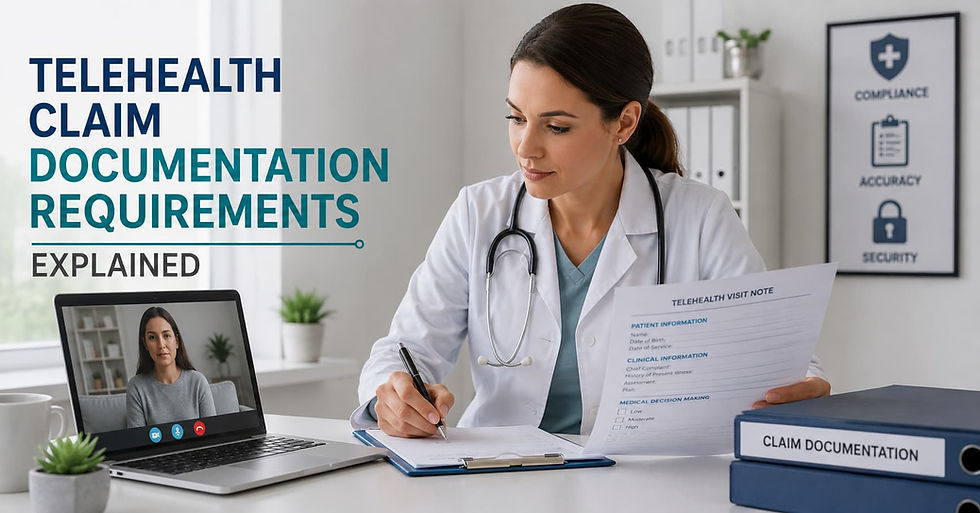
Telehealth claim documentation includes patient information, clinical notes, diagnosis coding, procedure coding, consent records, and details about the virtual encounter. Healthcare organizations often partner with experienced RCM experts to ensure documentation meets payer expectations while improving billing accuracy and operational efficiency.
Understanding Telehealth Documentation
What Is Telehealth Claim Documentation?
Telehealth claim documentation is the process of recording all information necessary to support a virtual healthcare service for accurate billing and reimbursement.
Documentation typically includes:
Patient demographics
Date and time of service
Provider information
Clinical assessment
Diagnosis codes
Procedure codes
Treatment plan
Follow-up recommendations
Complete documentation supports clean claim submission.
Why Documentation Matters
Accurate records demonstrate medical necessity, support coding accuracy, and help providers comply with payer policies.
Good documentation also prepares practices for audits.
Role in Revenue Cycle Management
Strong documentation improves reimbursement while reducing billing errors and claim delays.
Patient Information Requirements
Verify Patient Identity
Documentation should confirm the patient's identity before the telehealth visit begins.
Record Demographic Information
Patient records should include accurate contact information, insurance details, and other required registration data.
Confirm Eligibility
Insurance coverage should be verified before the appointment whenever possible.
Telehealth Encounter Details
Date and Time of Service
Medical records should clearly document when the telehealth encounter occurred.
Type of Telehealth Visit
Providers should identify whether the visit was conducted through video, audio-only communication (when permitted), or another approved telehealth platform.
Provider Information
Documentation should identify the healthcare professional who delivered the service, along with appropriate credentials.
Clinical Documentation
Chief Complaint
Record the patient's primary reason for seeking care.
Medical History
Document relevant medical history, current symptoms, medications, and other clinically significant information.
Clinical Assessment
Include examination findings that can reasonably be obtained during a virtual visit, clinical impressions, diagnosis, and medical decision-making.
Treatment Plan
Document recommended treatments, medications, patient education, referrals, and follow-up instructions.
Coding Requirements
Diagnosis Coding
Assign ICD-10 diagnosis codes that accurately reflect the patient's documented condition.
Procedure Coding
Use the appropriate CPT or HCPCS procedure codes that correspond to the telehealth service provided.
Required Modifiers
Apply payer-required telehealth modifiers and place-of-service indicators when applicable according to current billing guidelines.
Patient Consent
Obtain Consent
When required by payer policies or regulations, document that the patient consented to receive services through telehealth.
Record Consent
The medical record should indicate when and how consent was obtained.
Maintain Documentation
Consent records should be retained according to organizational policies and applicable regulations.
Insurance Verification
Confirm Benefits
Before the appointment, verify:
Active insurance coverage
Telehealth benefits
Covered services
Prior authorization requirements
Patient financial responsibility
Verification helps reduce avoidable claim denials.
Review Payer Policies
Telehealth coverage requirements may vary among insurance carriers and health plans.
Providers should follow payer-specific billing instructions.
Common Documentation Challenges
Incomplete Clinical Notes
Missing documentation may fail to support medical necessity or coding accuracy.
Coding Errors
Incorrect diagnosis or procedure coding can delay reimbursement or result in denied claims.
Missing Consent Records
Failure to document required patient consent may create compliance issues.
Technology Supporting Telehealth Billing
Electronic Health Records
EHR systems improve documentation consistency and simplify claim preparation.
Practice Management Software
Integrated billing platforms assist with scheduling, coding, claim submission, and payment tracking.
Secure Telehealth Platforms
HIPAA-compliant telehealth systems support secure communication and accurate visit documentation.
Best Practices for Telehealth Documentation
Document Every Virtual Encounter
Maintain complete clinical records for every telehealth visit.
Verify Insurance Before Services
Confirm telehealth coverage, benefits, and authorization requirements in advance.
Review Claims Before Submission
Quality assurance reviews help identify documentation and coding errors before claims are transmitted.
Train Staff Regularly
Provide ongoing education regarding telehealth documentation standards, coding updates, and payer requirements.
Many healthcare organizations rely on professional telehealth billing services and experienced RCM experts to improve documentation quality, maintain compliance, reduce claim denials, and strengthen revenue cycle performance.
Benefits of Accurate Telehealth Documentation
Improved Reimbursement
Complete documentation supports timely claim processing and payment.
Reduced Claim Denials
Accurate coding and thorough records improve first-pass claim acceptance.
Enhanced Compliance
Proper documentation helps organizations meet payer requirements and healthcare regulations.
Better Revenue Cycle Performance
Efficient documentation and billing workflows contribute to long-term financial stability.
Frequently Asked Questions
What should telehealth claim documentation include?
Documentation should include patient demographics, visit date and time, provider information, clinical notes, diagnosis codes, procedure codes, treatment plans, and follow-up instructions.
Why is documentation important for telehealth claims?
Complete documentation supports medical necessity, coding accuracy, payer compliance, and successful reimbursement.
Should patient consent be documented?
Yes. When required by payer policies or applicable regulations, patient consent for telehealth services should be documented and retained.
Why is insurance verification important before telehealth visits?
Insurance verification confirms telehealth coverage, authorization requirements, and patient financial responsibility, helping reduce claim denials.
How can healthcare organizations improve telehealth documentation?
Organizations can improve documentation by using standardized templates, maintaining complete clinical records, verifying insurance benefits, training staff, conducting regular audits, and partnering with experienced billing professionals.
Accurate telehealth claim documentation is essential for successful reimbursement, regulatory compliance, and efficient revenue cycle management. By maintaining complete patient records, documenting virtual encounters thoroughly, using accurate coding, verifying insurance coverage, and following payer-specific requirements, healthcare providers can reduce claim denials and improve operational efficiency. Practices that utilize professional telehealth billing services and collaborate with experienced RCM Experts are better equipped to achieve consistent billing accuracy and long-term financial success.


Comments